
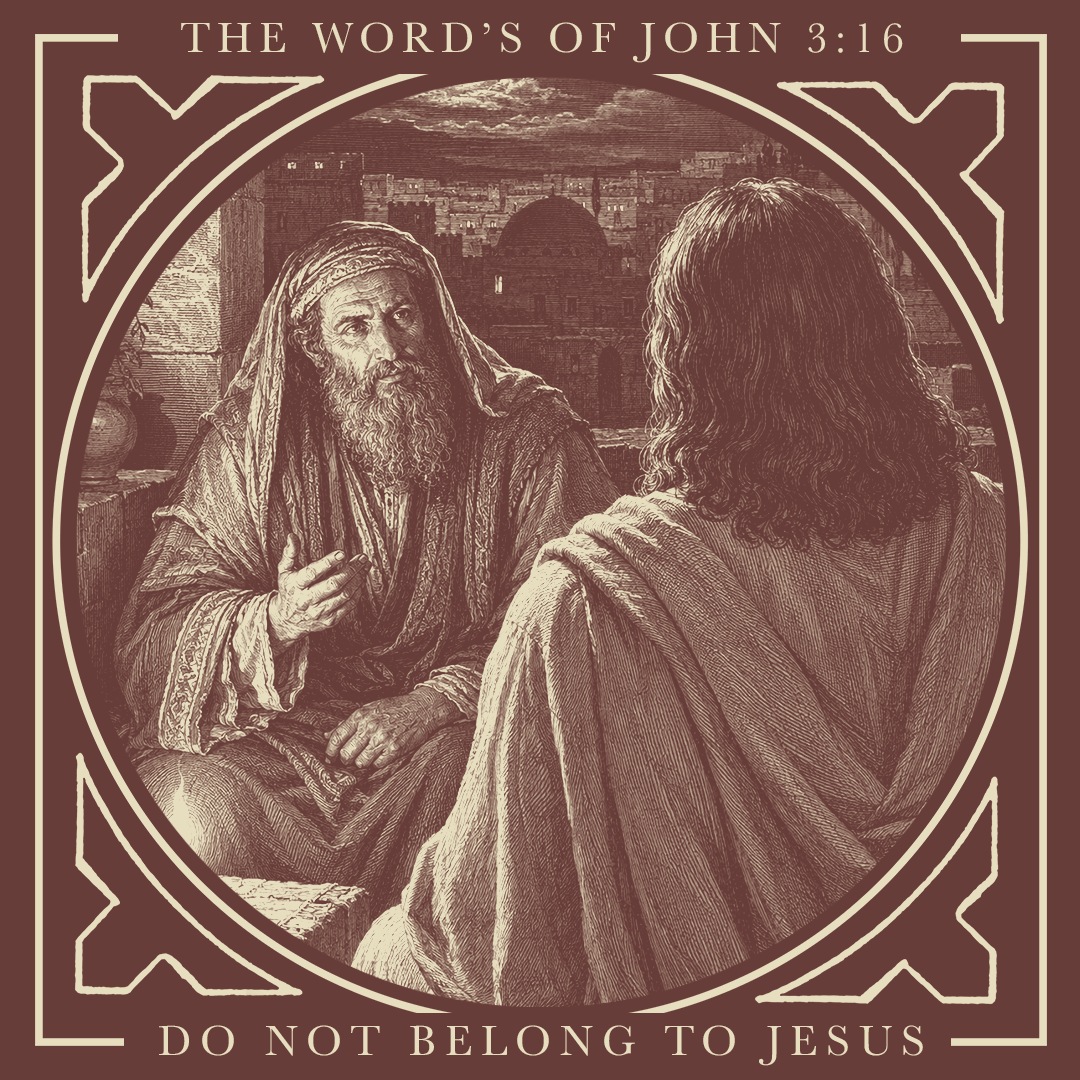
John 3:16 Are Not The Word’s Of Jesus
Who’s talking in John 3:16? Why verses 16-21 probably aren’t Jesus anymore
If you own a red-letter Bible, look at John 3 right now. The red ink runs through verse 15. Then, depending on your edition, it either keeps going through verse 21, or it stops. That inconsistency isn’t a printing error. It’s an argument Bible publishers have never fully settled. The Greek text never tells us exactly where Jesus stops talking and John starts explaining.
I noticed this while preparing week five of our inner healing series. I was working back through John 3, maybe for the tenth time in my life. This time I stopped at verse 16 and asked a question I’d never really sat with. Did Jesus say this to Nicodemus? Or is this John, decades later, writing his own reflection on what Jesus said?
The more commentaries I opened, the clearer the answer became. Most serious Johannine scholars think verses 16-21 are John’s voice, not a transcript of Jesus. Here’s the case, and why it actually matters.
The clue in the tense
The first thing that tipped me off wasn’t a commentary. It was just reading the Greek verb forms side by side. Through verse 15, Jesus speaks in the present tense. That’s the tense of someone mid-conversation, still working through an idea with the person in front of him. Starting at verse 16, the verbs shift into the aorist, a past tense. That tense treats the cross and the mission of the Son as history already settled, not something still unfolding in the room.
That’s not how you talk to somebody while you’re still explaining something to them. You talk that way about an event after it’s happened, after you’ve had time to think about what it meant. Nicodemus is standing in front of Jesus at night, before the cross, before the resurrection. John is writing sixty years later, after all of it. The verbs know the difference.
What the commentators say
Once I checked this against actual scholarship, the tense shift turned out to be the tip of a much bigger iceberg. Colin Kruse states plainly that the account of the exchange runs from 3:1 to 15. The evangelist’s comments, he says, run from 16 to 21.[^1] Bruce Milne makes the same call. He notes a real symmetry to the chapter. Jesus’ words trail off at the end of verse 15, and the meditation of the Evangelist picks up in 16-21. The same pattern shows up later in the chapter. John the Baptist’s words end at verse 30, and John’s own reflection picks up in 31-36.[^2]
Rodney Whitacre writes that verse 16 marks “the beginning of a commentary on the different responses to this revelation.” He adds that John is likely “stepping back to summarize and reflect on what has just been narrated.”[^3]
What the wording gives away
D.A. Carson tends to be cautious about this kind of source-critical move, but he lands in the same place. He points to the phrase “one and only” (monogenes). That’s Johannine vocabulary, the term the Evangelist uses in his own voice at 1:14, 1:18, and again in 1 John 4:9. Jesus never uses it anywhere else in this Gospel. Carson also notes that Jesus doesn’t normally call God “ho theos,” simply “God,” in this Gospel. Jesus calls his Father “Father.” But in verse 16, “God” gave his Son. That’s John’s language describing what Jesus did, not Jesus’ own way of naming his Father.[^4]
Craig Keener adds a structural observation. The third “truly, truly” statement of the chapter comes in verse 11. That formula introduces what he calls “the first of the extended didactic sections” in the Gospel. It’s a section that moves from dialogue into monologue, and finally into “a paragraph of reflection by the Evangelist.”[^5] Keener leaves open the possibility that Jesus’ words run through verse 21. Still, he agrees the meditation reads far more plausibly as John’s.
Gerald Borchert is willing to let more of the ambiguity stand unresolved, but he spends pages on this same question. He asks what every red-letter Bible forces on us: who was actually responsible for verse 16? Did Jesus say it, or did John write it about Jesus?[^6]
The “you” changes
There’s another clue sitting right in the pronouns, one you can see without any Greek. Jesus starts this conversation speaking to Nicodemus as an individual, singular “you,” in verse 3 and verse 5. By verse 7 that shifts to plural: “you (all) must be born again.” By verse 11, Jesus speaks as “we” against a “you people” who reject “our” testimony. Then verse 16 opens into “whoever” and “the world,” language aimed at nobody in the room. John never names Nicodemus again after verse 10. The conversation has stopped being two men talking in a courtyard at night. It has become a statement aimed past Nicodemus, straight at the reader.
That’s exactly what you’d expect if John paused his narrative here. He was writing to churches full of Jews and Gentiles who never met Nicodemus and never will, and he wanted them to feel the weight of what they’d just watched happen. This isn’t eavesdropping on a private conversation anymore. It’s preaching.
It doesn’t touch inspiration
Not one bit, and it’s worth saying that plainly instead of leaving people worried Scripture just got less trustworthy. Borchert makes the point I keep coming back to. If verses 16-21 are a theological confession from John about the Son of God, that doesn’t lower their authority. They carry the same weight as if Jesus had said them out loud himself.[^7] The whole Gospel of John carries the same inspiration, red letters and black letters both. Sorting out which words came from Jesus’ mouth that night, and which came from John’s pen decades later, is a different question. It doesn’t touch inspiration at all. It’s a question about literary structure, not about truth.
What actually changes
“For God so loved the world” isn’t Jesus mid-argument with a Pharisee. He isn’t suddenly switching gears to deliver a stand-alone altar call. It’s John. He just told us about the most important conversation in his Gospel, and now he’s stopping to spell out exactly what we were supposed to take from it. He’s doing what any of us do after telling a story that matters. He’s making sure nobody misses the point.
That’s actually the stronger claim. John isn’t guessing at what this encounter meant. He was there, or close enough to it. Decades later, he told his church exactly what all that talk about being born of water and Spirit was for. God loved the world enough to give his Son. Not to condemn it. To save it. And here’s the choice everybody now faces, in the light of the cross Jesus already told Nicodemus about.
The next time you read John 3:16 out loud, you’re most likely reading the pastor’s voice, not the rabbi’s. John wrote it under inspiration. He was telling his church exactly what happened in the dark with Nicodemus, and what it meant for every reader who would come after them.
Notes
[^1]: Colin G. Kruse, John: An Introduction and Commentary, Tyndale New Testament Commentaries (Leicester: IVP; Grand Rapids: Eerdmans), commentary on John 3:1-21.
[^2]: Bruce Milne, The Message of John: Here Is Your King!, The Bible Speaks Today (Downers Grove, IL: IVP), commentary on John 3:1-21.
[^3]: Rodney A. Whitacre, John, IVP New Testament Commentary Series (Downers Grove, IL: IVP), commentary on John 3:15-16.
[^4]: D. A. Carson, The Gospel According to John, Pillar New Testament Commentary (Grand Rapids: Eerdmans), commentary on John 3:16-21.
[^5]: Craig S. Keener, The Gospel of John: A Commentary (Peabody, MA: Hendrickson), commentary on John 3:11 and 3:16-18.
[^6]: Gerald L. Borchert, John 1-11, New American Commentary (Nashville: Broadman & Holman), commentary on John 3:11-13 and 3:16-18.
[^7]: Borchert, John 1-11, commentary on John 3:11-13.
Visit our home page: KingsFellowshipChurch.com
1001 Tipton Terrace, Ada, OK, United States, Oklahoma