
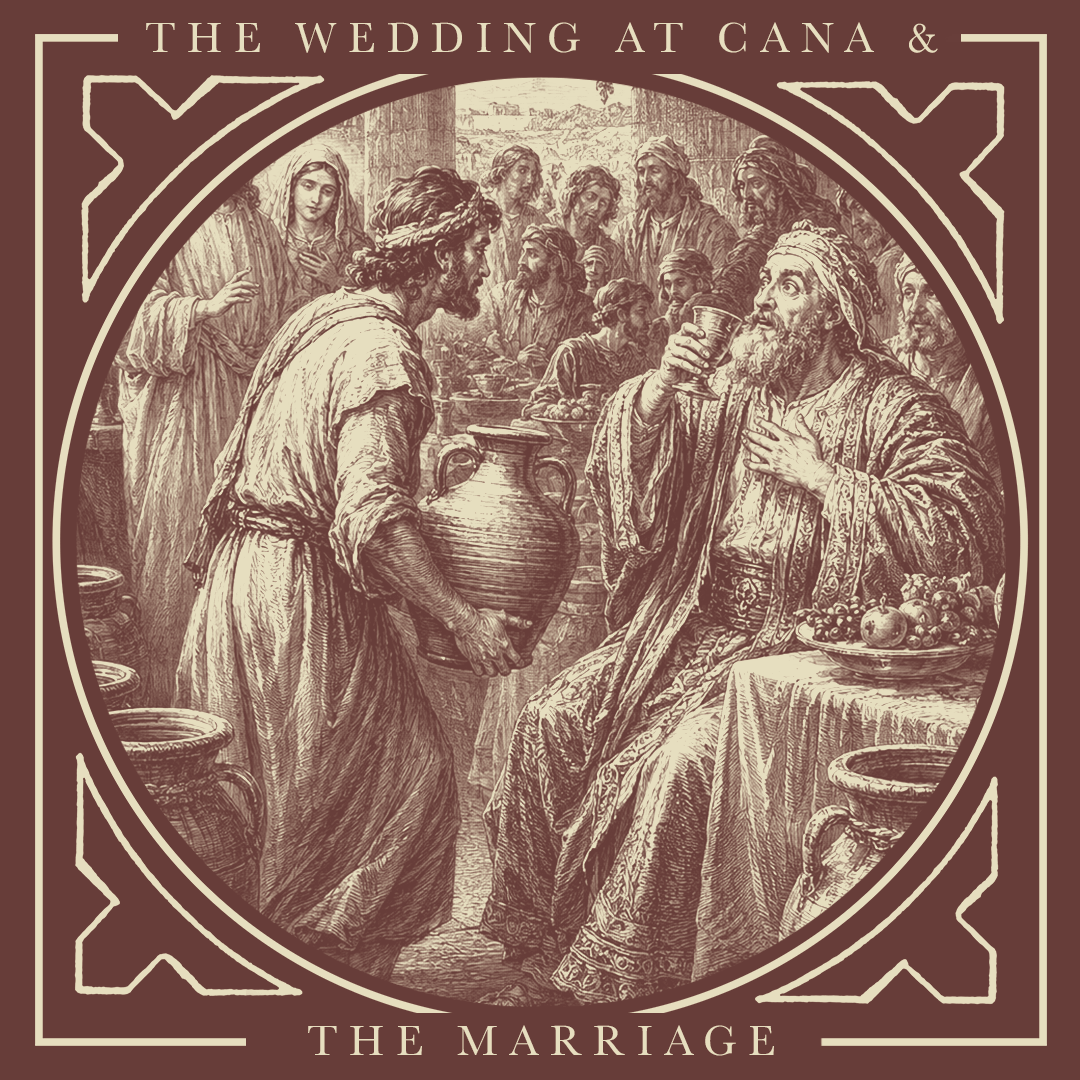
The Wedding Of Cana & The Marriage Supper Of The Lamb
Cana Is a Preview of the Marriage Supper of the Lamb
John tells you exactly what he’s doing with this story before you even finish reading it. Verse 11: “This, the first of his signs, Jesus did at Cana in Galilee, and manifested his glory.” In other words, he’s not just recording a nice memory from a family friend’s wedding. He’s telling you this event is a window into who Jesus is. And one of the things it reveals is that Jesus is the true bridegroom — the one every wedding in Scripture has been waiting for.
John already cast Jesus as the bridegroom before Cana ever happened
Turn back one chapter first, and you’ll see John setting this up in advance. John the Baptist tells the crowd he isn’t worthy to untie the sandal of the one coming after him. That’s not just a humility line. Instead, it echoes an old custom tied to securing the right to marry. In other words, John the Baptist is already handing Jesus the role of bridegroom before Jesus ever shows up at an actual wedding. So by the time Cana happens in chapter 2, Jesus isn’t picking up a new title. He’s simply stepping into the one John already gave him.
The wedding this whole story is pointing toward
Revelation 19 pictures a sound like the roar of many waters, a great multitude crying out because “the marriage of the Lamb has come, and his Bride has made herself ready.” An angel then dictates a line to John, word for word: “Blessed are those who are invited to the marriage supper of the Lamb.” Finally the angel adds, “These are the true words of God,” as if John needed the extra assurance that this wasn’t a metaphor getting away from him.
That, ultimately, is the wedding Cana was pointing to the entire time. Cana isn’t the destination. Rather, it’s a preview, decades ahead of the release date, of the one wedding every other wedding in Scripture has been building toward.
A bridegroom running through the whole Bible
This isn’t the first time God has used a wedding to describe himself. In fact, the pattern runs from Genesis all the way to Revelation, and Cana takes its place inside that pattern instead of standing apart from it.
- First, Eve is taken from Adam’s side. Likewise, the church comes from Christ’s pierced side.
- Then in Genesis 24, Abraham sends his servant, a picture of the Holy Spirit, to go find a bride for Isaac, a picture of Christ.
- Similarly, in Ruth 4, Boaz redeems Ruth. Jesus redeems his people the same way, at the cost of his own blood.
- Meanwhile, Hosea keeps pursuing Gomer even after she runs from him, which is Christ pursuing a people who keep running from him.
- And for centuries, the church read the Song of Solomon as a picture of God’s own love for his people.
Put those together, and Cana stops looking like an isolated miracle. Instead, it’s one more entry in a story God has been telling since Adam: a bridegroom who provides, who loves, and who goes to any length to redeem his bride.
Why Jesus gives a preview before the hour has come
Jesus tells his mother plainly that his hour hasn’t come yet. In other words, he knows the real wedding, the one Revelation describes, is still ahead of him — secured on the far side of the cross and made certain by the resurrection. Even so, he fills six jars to the brim anyway, because grace doesn’t wait until the main event to start handing things out. As a result, the guests at Cana got an actual taste of the last wedding in history before that wedding had even been secured.
That’s precisely what makes the “not yet” of Cana good news instead of a delay. The hour hadn’t come, and yet Jesus gave a preview regardless. So the wedding feast was still future, and people at a small-town wedding tasted a piece of it anyway.
The Lord’s Supper keeps the preview running
This didn’t stop at Cana, though. Every time the church takes communion, it’s tasting the same future those wedding guests tasted first. After all, Jesus told his disciples he wouldn’t drink of the fruit of the vine again until that day in the kingdom, which ties the Supper directly to the marriage feast still ahead. So the wine at Cana and the cup at the table are the same sign, given twice: proof that the bridegroom has already shown up once, and a promise that he’s coming back to finish what he started.
What this means for how you pray
Here’s where this stops being a Bible study point and starts being something you can actually do this week.
First, notice what Mary brings to Jesus at Cana. Not a request for revival. Not a request for national repentance. Just, “They have no wine.” In short, it’s a small, almost embarrassing problem at a wedding that wasn’t even hers to host. Yet Jesus doesn’t brush it off as beneath him. Instead, he turns it into the first sign that reveals his glory.
If Cana really is a foretaste of the wedding feast to come, then Mary’s small request becomes a model for something bigger than good hospitality. Because she brought an ordinary, unglamorous need to Jesus, and he answered it in a way that pointed straight at the age to come. Therefore, you don’t need a “kingdom-sized” problem before you’re allowed to ask boldly.
Praying like Mary did
The healing you want for your body. The peace you want in your home. The presence of God you want to feel, not just believe in. None of these are beneath the God who is planning a marriage supper. On the contrary, they’re exactly the kind of thing he uses to give people a taste of it now.
So pray like Mary did. Lord, we know you will one day heal every disease — would you heal now? Likewise, we know we will one day see you face to face — would you let us feel your presence even now? And we know you will one day make everything right — would you bring justice and deliverance now? These aren’t presumptuous prayers. Rather, they’re the same kind of prayer that got six jars filled with wine at a wedding in Galilee, rooted in a God whose whole plan for history ends at a marriage supper he has already promised to keep.
Visit our home page: KingsFellowshipChurch.com
1001 Tipton Terrace, Ada, OK, United States, Oklahoma