
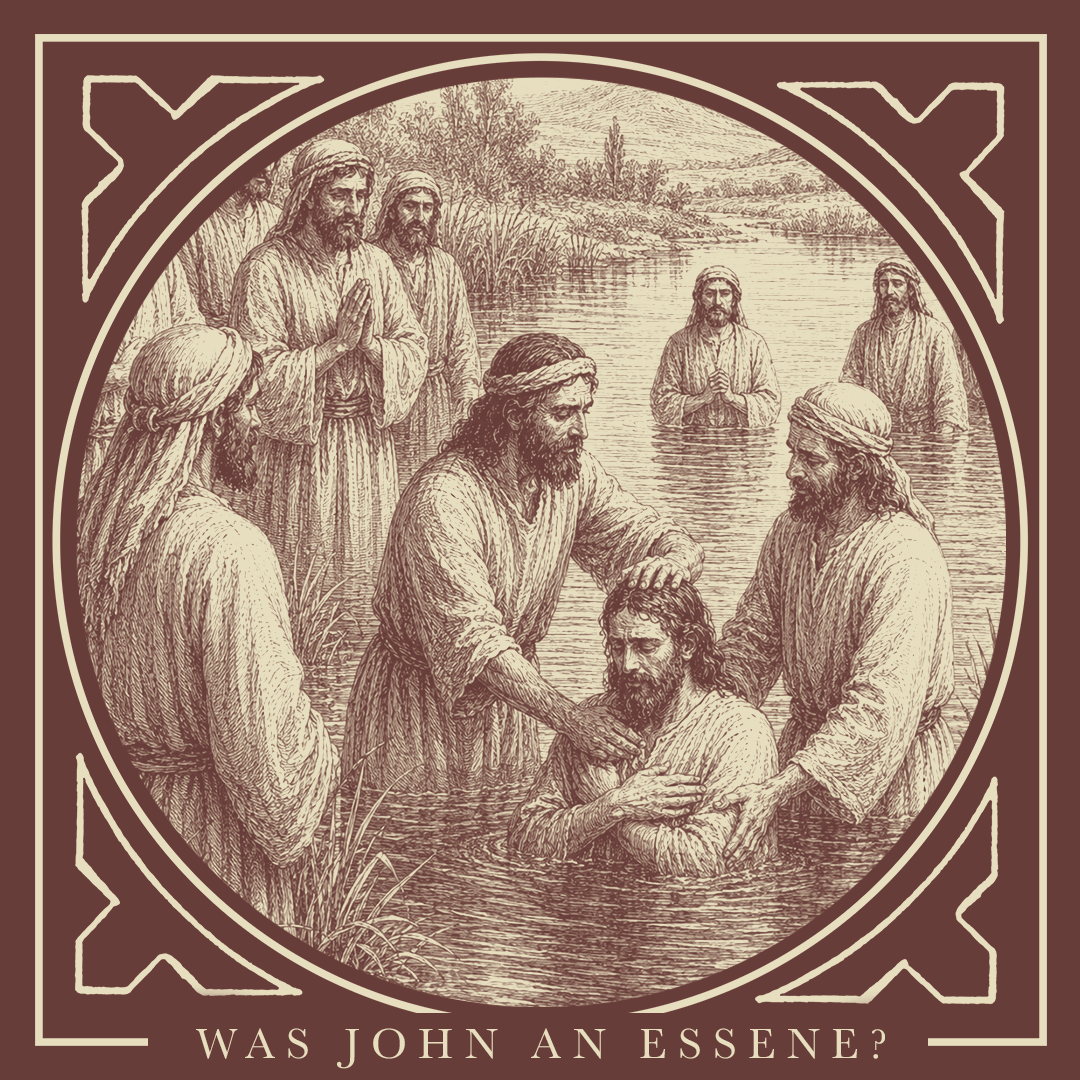
Was John the Baptist an Essene?
Was John the Baptist a Member of the Essenes?
John the Baptist ate locusts, lived in the wilderness, wore camel’s hair, and baptized people in the Jordan. A few miles from where he preached, a Jewish sect called the Essenes was doing something strikingly similar. They lived apart from Jerusalem, washed ritually, and read Isaiah 40:3 as their own mission statement. So was John the Baptist an Essene? No ancient source says so directly. But the circumstantial case is strong enough that scholars have argued it seriously for over a century. Here is what the evidence actually shows, and why it matters for how we read John’s ministry in the Gospels.
Who were the Essenes?
The Essenes were one of three major Jewish groups active in the first century, alongside the Pharisees and Sadducees. Josephus lists them by name in the Jewish War. He describes a group that “pretends to a severer discipline” than the others and that shows unusual affection for one another.[1] Philo of Alexandria and Pliny the Elder describe the same group independently. Most scholars connect them to the ruins at Qumran, where the Dead Sea Scrolls were found starting in 1947.
The Essenes lived communally, rejected private wealth, and were largely celibate, though Josephus mentions a smaller marrying branch.[2] They avoided luxury and considered pleasure a vice. They believed they were living in the last days before God’s final judgment. Their founding document, the Community Rule, describes members separating from “the session of perverse men” to go into the wilderness and prepare the way of the Lord. This section quotes Isaiah 40:3 directly.[3] That is the same verse John the Baptist quotes about himself in John 1:23.
What the Gospels tell us about John’s own baptism
Mark 1:4 describes John preaching “a baptism of repentance for the forgiveness of sins.” Mark adds that “all the country of Judea and Jerusalem” went out to him (Mark 1:5). Matthew 3:4 gives the detail his own congregation handout draws on: camel’s hair clothing and a leather belt. His diet was locusts and wild honey. Luke 1:80 says John “was in the wilderness until the day of his public appearance to Israel.” That places his formation, not just his ministry, in that same desert region.
None of these verses mention the Essenes. That silence cuts both ways. It means the connection has to be built from circumstantial overlap rather than a direct statement. But it also means something else: the Gospels had no reason to name a group whose relevance to John’s biography, if any, was already assumed background. It was not a plot point that needed explaining.
The case that John the Baptist was an Essene
Several details line up. John’s father Zechariah was a priest serving in the Jerusalem temple (Luke 1:5,8). The Essenes were largely made up of priests who had walked away from a temple leadership they considered corrupt. Many scholars trace this rupture to 152 BCE. That year the Hasmonean Jonathan took the office of high priest, even though he had no claim to the traditional Zadokite priestly line.[4] A wing of priests thought the office now belonged to an illegitimate family. They withdrew to the desert rather than serve under it.
John grew up in “the wilderness” (Luke 1:80). He later preached and baptized in the same general region, near the Jordan across from Jericho, not far from Qumran. His ministry combined a priestly pedigree with a wilderness address and a baptism of repentance. That combination is close to the Essene profile.
The Essenes also practiced ritual immersion as part of their communal life. Josephus records that certain Essene prophets, including one named Judas and another named Menahem, made predictions that he says came true.[5] Whether or not John trained among them, the overlap is striking. The combination of “priest’s son,” “wilderness,” and “water ritual with eschatological urgency” is exactly why the Essene theory keeps getting revisited.
Bible historian Heinrich Graetz went furthest in the nineteenth century. He argued the name “John” itself pointed to an Essene identity, since he read it as meaning something like “he who cleanses.”[6] Most scholars today do not follow Graetz that far, but the underlying question he raised has not gone away.
Why most scholars say John the Baptist was not an Essene
The strongest response comes from Ian Werrett, who argues the evidence for real overlap breaks down under scrutiny.[7] Qumran’s ritual washing required lengthy probation and physical wholeness for entry. John’s public, one-time baptism of “all Judea and Jerusalem” (Mark 1:5) did not share those standards. Qumran’s members separated from outsiders as a matter of purity; John invited the crowd in. The Essenes guarded strict secrecy about internal teaching; John preached in the open, to soldiers, tax collectors, and Pharisees alike.
A middle position, developed most fully by Joel Marcus, takes a different view. John may have spent time at Qumran as a young man and then left the community to pursue his own public calling.[8] James Charlesworth has argued along similar lines. Catholic scholar John Bergsma has made the case that the parallels are close enough to suggest formation, even if not lifelong membership.[9] On this reading, John absorbed the sect’s wilderness spirituality and its reading of Isaiah 40:3. He then broke from its separatism once his own mission became clear.
Does it matter whether John the Baptist was an Essene?
Even without certainty, the Essene background sharpens a few things in the text. It explains why “the voice of one crying in the wilderness” was not an odd or invented image for John’s first hearers. It was already a live category. That category was associated with a known sect that had been reading Isaiah that way for over a century before John showed up. When John applies the verse to himself in John 1:23, he is stepping into an interpretive tradition his audience would recognize. Then he redirects it: not toward a communal separation from Israel, but toward one specific man standing at the river.
It also sharpens the contrast in the text itself. If John came out of a movement built on withdrawal, secrecy, and probation, that matters. His choice to baptize publicly and immediately, without the entry requirements Qumran demanded, was a real departure. He kept the wilderness and the water. He dropped the gate.
None of this is provable from the Gospels alone. But it is a live enough question in serious scholarship. It is worth knowing the shape of the argument, on both sides, next time you read John 1.
Notes
- Josephus, Jewish War 2.119, translated by William Whiston, available via Lexundria: https://lexundria.com/j_bj/2.117-2.166/wst
- Josephus, Jewish War 2.120-121, same source as above.
- Community Rule (1QS) 8:12-16, discussed in “The Dead Sea Scrolls and the New Testament,” BYU Religious Studies Center: https://rsc.byu.edu/new-testament-history-culture-society/dead-sea-scrolls-new-testament
- On the 152 BCE Hasmonean high priesthood and the Zadokite break, see the Bible Odyssey overview and Knowledge for Life’s summary of the Maccabean revolt: https://knowledgeforlife.contextostudios.com/history/the-maccabean-revolt/
- Josephus records the Essene prophets Judas, Menahem, and Simon in Jewish War and Antiquities; summarized in the Jewish Encyclopedia entry on the Essenes: https://jewishencyclopedia.com/articles/5867-essenes
- Heinrich Graetz’s argument is discussed in Cody Woodruff, “John the Baptist and the Qumran Connection,” BYU Studia Antiqua: https://scholarsarchive.byu.edu/cgi/viewcontent.cgi?article=1126&context=studiaantiqua
- Ian Werrett, “John the Baptist and the Essenes,” Bible Odyssey: https://www.bibleodyssey.org/articles/john-the-baptist-and-the-essenes/
- Joel Marcus’s position is summarized in “Essenes: Beliefs, Significance, Links to Dead Sea Scrolls,” bartehrman.com: https://www.bartehrman.com/essenes/
- On Charlesworth and Bergsma, see “John the Baptizer and Qumran,” Bible Odyssey: https://www.bibleodyssey.org/articles/john-the-baptizer-and-qumran/, and “John the Baptist and the Essenes,” St. John Vianney Lay Division: https://sjvlaydivision.org/john-the-baptist-essenes/
Visit our home page: KingsFellowshipChurch.com
1001 Tipton Terrace, Ada, OK, United States, Oklahoma