
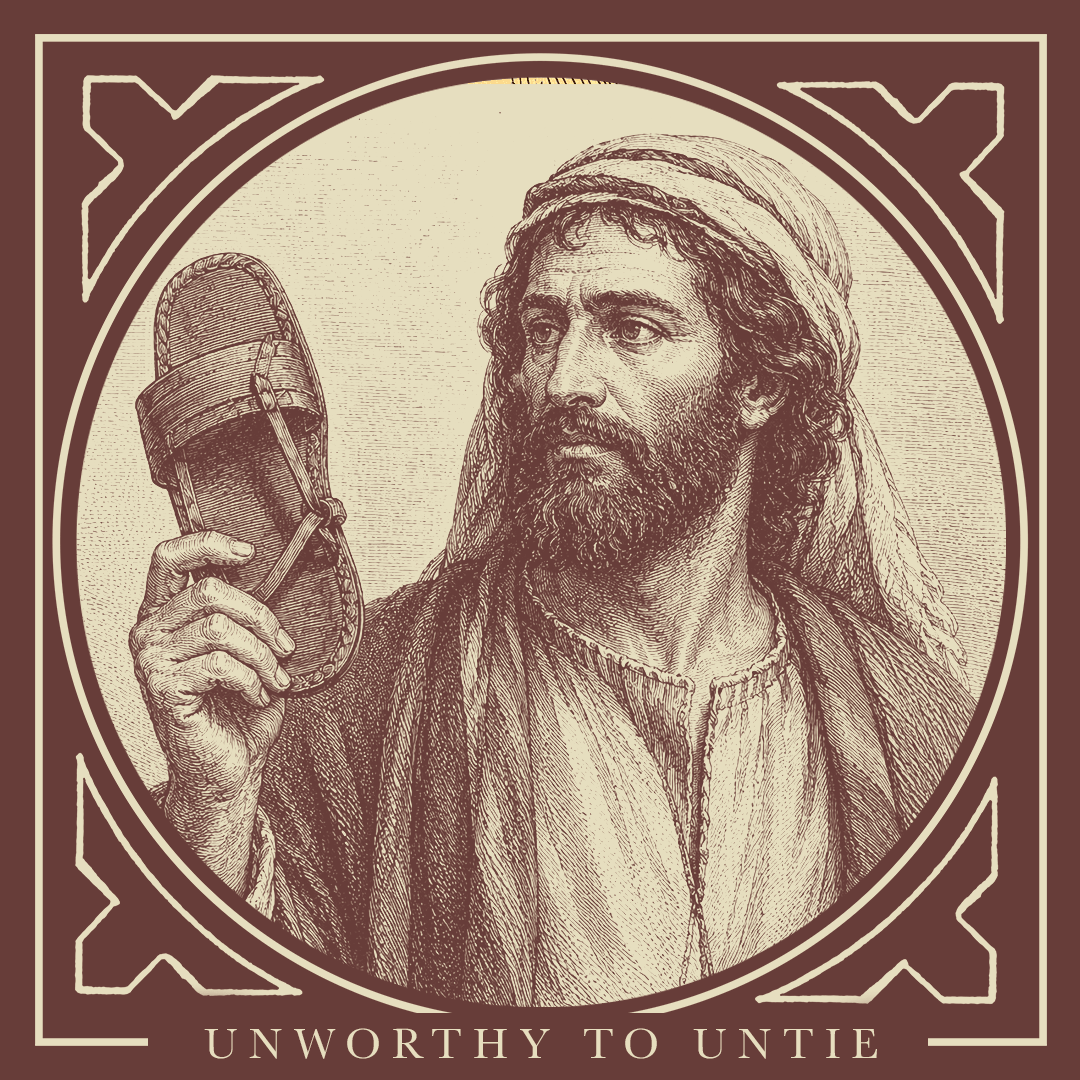
The Real Meaning of John 1:27
Unworthy to Untie His Sandal: The Real Meaning of John 1:27
What John the Baptist meant when he said he wasn’t worthy to loose Jesus’ sandal strap, and why John 2 and John 3 prove it.
“The strap of whose sandal I am not worthy to untie.”
Most preaching on John 1:27 stops at general humility. John is a big deal. Jesus is a bigger deal. That’s the whole point, as far as it goes. However, that’s not what the line actually says. It’s not how the church read it for its first thousand years either. Instead, I think John is making a specific legal claim about who has the right to marry Israel. And I think the rest of his Gospel proves it.
The law behind the sandal
Deuteronomy 25:5-10 covers what happens when a man dies without a son. His brother must marry the widow and raise up an heir in the dead brother’s name. If he refuses, though, a public ceremony follows. The widow pulls the sandal off his foot and spits in his face. As a result, people call his family “the house of him whose sandal is removed” (Deuteronomy 25:10).
Ruth 4, meanwhile, shows the ceremony running the other direction. A closer relative holds the first right to redeem Ruth, but he declines. So he pulls off his own sandal and hands it to Boaz in front of the town elders. That transfer gives Boaz the legal right to marry her (Ruth 4:7-8). In other words, the sandal is the credential. Whoever holds it holds the claim to the bride.
Now put John’s words back in that frame. They stop sounding like a vague compliment. “I am not worthy to untie the strap of his sandal” is, in fact, John saying: I have no claim on this bride. He does.
Gregory the Great already preached this
This reading isn’t new. Pope Gregory the Great preached it directly around AD 591. He delivered it in the fourth of his Forty Gospel Homilies, on this exact text, John 1:19-27. There, Gregory tells his congregation that ancient custom required an unwilling kinsman to hand over his sandal. The man who took the widow in his place received it. Gregory then applies that custom directly to John’s words about Christ.[1] So he isn’t using the sandal line as an isolated metaphor for lowliness. Rather, he cites the actual marriage law behind it and tells his people that’s what John meant.
Aquinas made the same argument by name
Six centuries later, Thomas Aquinas preached the same connection in his commentary on John’s Gospel. He works through Deuteronomy 25 verse by verse. A kinsman who refused to marry a widow, he explains, had his sandal removed as a public sign. Aquinas then applies it to the Baptist. In refusing to touch Christ’s sandal, he writes, John means he isn’t worthy to have the bride, the Church, since that right belongs to Christ alone.[2]
So two of the most influential minds in the Latin church, five hundred years apart, reached the same legal reading independently. Consequently, this isn’t a fringe interpretation. It’s simply one the church stopped teaching.
Why the chapter order can’t be an accident
Here’s the piece that, in my view, gets missed even by people who already know the levirate background. John doesn’t drop this legal image in chapter 1 and move on to something else. Instead, turn the page.
The wedding at Cana
John 2 opens at a wedding. Not a parable about one, but an actual wedding at Cana. There, Jesus performs his first sign. Out of every possible starting miracle, the Gospel writer chose a wedding feast. He placed it immediately after the sandal comment.
The friend of the bridegroom
Then, in John 3:29, John the Baptist finally finishes the sentence he started two chapters earlier. Someone asks him about Jesus drawing followers away from him. He answers: “The one who has the bride is the bridegroom. The friend of the bridegroom, who stands and hears him, rejoices greatly at the bridegroom’s voice.” Here, he names his own role. Not the bridegroom, but the friend of the bridegroom, the man who arranges the marriage and then steps back once the groom arrives.
This isn’t just my hunch, either. A Cambridge University Press study by Jocelyn McWhirter traces the same progression as a deliberate literary unit. Jesus appears as bridegroom-Messiah at Cana in chapter 2. Then John the Baptist confirms that identity at Aenon in chapter 3.[3] First comes the sandal law in chapter 1. Then a literal wedding in chapter 2. Finally, explicit bridegroom language in chapter 3. In short, that’s one argument, built one chapter at a time.
What I think this means, and where I can’t prove it
I think John the Baptist knew something from his very first interrogation by the priests and Levites. He knew Jesus was arriving as Israel’s bridegroom, the one with the legal right to the bride he wasn’t fit to touch. I also think the Gospel of John follows a set order to make sure the reader catches it: the legal claim first, then the wedding, then John saying it outright.
Still, I want to be honest about where my certainty runs out. I can’t prove this was John the Baptist’s conscious intent in the moment. I likewise can’t prove the Gospel writer chose this order for this exact reason, rather than simply following events as they happened. Scripture doesn’t hand us a footnote confirming it. Nevertheless, Gregory the Great and Aquinas both read the sandal line through this same legal lens centuries before I did. And the chapter sequence lines up with a precision I don’t think is accidental. So I hold this with real conviction. I just don’t hold it as the only possible reading.
Either way, it’s the same picture Scripture keeps returning to from Eden to Revelation. God pursues his people as a bridegroom pursues a bride. Perhaps John the Baptist was the first person standing in the Jordan to see that the bridegroom had finally arrived.
Notes
- Gregory the Great, Homily 4, “The Record of John (John 1:19-27),” in Forty Gospel Homilies, trans. Dom David Hurst, Cistercian Studies Series 123 (Kalamazoo: Cistercian Publications, 1990), 21-27.
- Thomas Aquinas, Commentary on the Gospel of John, ch. 1, lecture 13 (on John 1:27).
- Jocelyn McWhirter, “The Glorification of the Bridegroom-Messiah,” in The Bridegroom Messiah and the People of God (Cambridge University Press, 2006).
Visit our home page: KingsFellowshipChurch.com
1001 Tipton Terrace, Ada, OK, United States, Oklahoma